IoT Real-Time
Monitoring System
ESP32-based sensor network continuously measuring slope tilt, soil moisture, and vibration with wireless cloud transmission.
The IoT Prototype
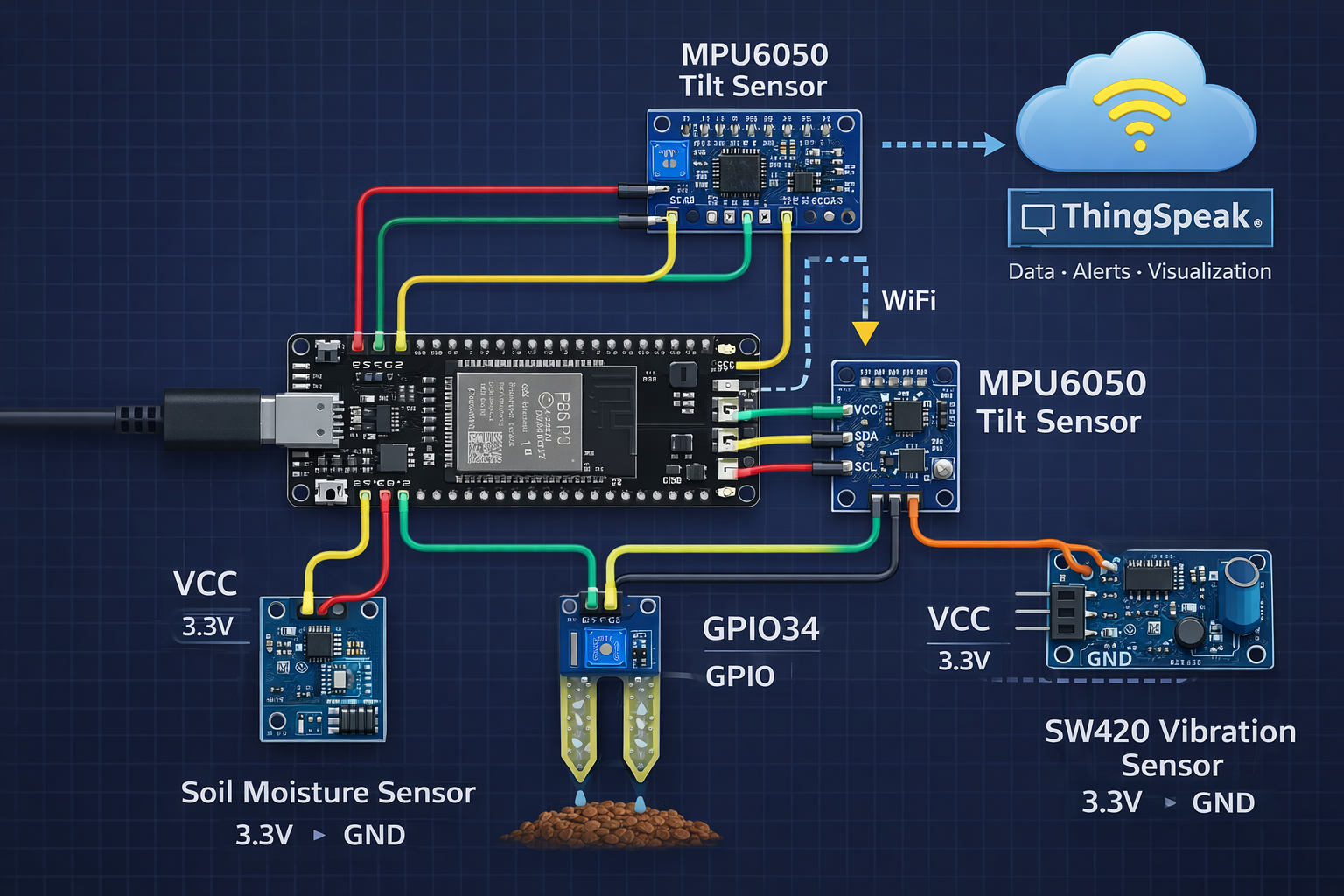
The IoT monitoring prototype is the core innovation of this research project. It uses a WiFi-enabled ESP32 microcontroller as the central processing unit, connected to three specialized sensors that measure the physical parameters most relevant to slope stability.
The system continuously reads sensor data, applies a slope stability algorithm to compute a real-time risk score, and transmits all readings wirelessly to the ThingSpeak cloud platform where they are stored and visualized.
When the computed Slope Stability Index (SSI) exceeds defined thresholds, the system automatically classifies the slope condition as WARNING or DANGER — enabling mine operators to take preventive action before a failure occurs.
Microcontroller
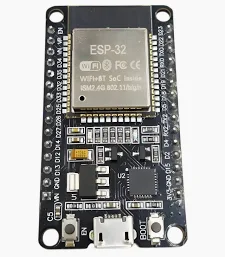
The ESP32 is the brain of the IoT monitoring system. This powerful WiFi and Bluetooth-enabled microcontroller is widely used in industrial IoT applications due to its dual-core processing capability and energy efficiency.
In this project, the ESP32 reads data from all three sensors via its analog and digital input pins, runs the Slope Stability Index algorithm, and transmits processed data to the ThingSpeak cloud platform over WiFi.
- Reading analog and digital signals from all sensor nodes
- Converting raw sensor data into calibrated physical units
- Computing the Slope Stability Index (SSI) in real-time
- Transmitting data to ThingSpeak via HTTP POST requests
- Controlling alert indicators based on risk thresholds
| Specification | Value |
|---|---|
| Processor | Xtensa dual-core LX6, up to 240 MHz |
| WiFi | 802.11 b/g/n (2.4 GHz) |
| Bluetooth | Classic + BLE 4.2 |
| Flash Memory | 4 MB (typical) |
| GPIO Pins | 34 programmable I/O pins |
| ADC Resolution | 12-bit (0–4095) |
| Operating Voltage | 3.3V (5V tolerant input) |
| Communication | UART, SPI, I2C, I2S |
Tilt Sensor
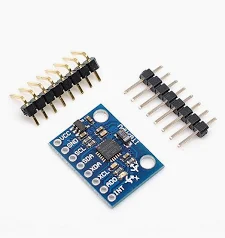
The MPU6050 is a 6-axis Inertial Measurement Unit (IMU) combining a 3-axis accelerometer and a 3-axis gyroscope in a single compact package. It communicates with the ESP32 via the I2C serial protocol.
Working Principle: The accelerometer measures gravitational acceleration components along the X, Y, and Z axes. When the sensor is tilted, the distribution of gravitational acceleration across the three axes changes. Using trigonometric transformation (arctan functions), the ESP32 calculates the precise tilt angle of the slope surface.
Pitch = arctan(-Ax / √(Ay² + Az²))
- Detects slope angle changes as small as fractions of a degree
- Identifies progressive slope deformation before failure
- Measures dynamic movement during vibration events
| Specification | Value |
|---|---|
| Accelerometer Range | ±2g, ±4g, ±8g, ±16g |
| Gyroscope Range | ±250–2000 °/s |
| Resolution | 16-bit ADC |
| Interface | I2C (400 kHz fast mode) |
| Operating Voltage | 3–5V |
| Temperature Sensor | Built-in (−40 to +85°C) |
Sensor
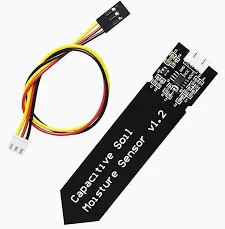
Water is the primary trigger of slope failures in open-cast mines. Rainfall infiltration increases soil pore pressure, reduces effective shear strength, and lubricates discontinuity surfaces — dramatically increasing the risk of slope sliding.
Working Principle: The soil moisture sensor measures the electrical conductivity (or capacitance in advanced models) of the surrounding soil. Since water is a conductor, soil with higher water content produces lower electrical resistance. The ESP32 reads this as a voltage value on its analog input pin and converts it to a percentage moisture reading.
- Detects water infiltration during and after rainfall events
- Tracks soil saturation levels approaching failure thresholds
- Provides early warning when soil moisture exceeds safe limits
- Critical indicator for post-blast slope safety assessment
Vibration Sensor
Vibration is a key indicator of slope instability. In mining environments, vibration events can originate from blasting operations, heavy machinery, or — critically — from ground movement within the slope itself.
Working Principle: The SW420 contains a vibration-sensitive tilt switch mechanism. When vibration exceeds the sensor's sensitivity threshold, the internal switch closes momentarily, sending a digital HIGH signal to the ESP32. This event is logged, time-stamped, and transmitted to the cloud.
- Detects vibration events from blasting, machinery, or ground movement
- Provides digital event triggers for immediate alerting
- Adjustable sensitivity threshold via onboard potentiometer
- Correlates vibration events with tilt and moisture data for context
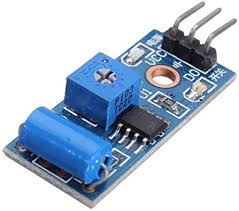
The SW420 outputs a digital binary signal: LOW (0) when no vibration is detected, and HIGH (1) when vibration exceeds the sensitivity threshold. This is connected directly to a GPIO pin on the ESP32.
Data Flow Pipeline
From physical sensor measurements to cloud-stored analytics and risk detection in under 5 seconds.
Moisture
SW420
SSI compute
Format
API Key
Auth
Charting
Fields 1–6
analysis
Alerts
WARNING /
DANGER